
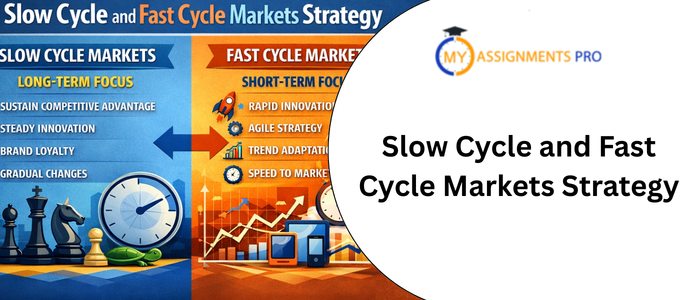
Understanding how markets change and how competitors behave over time is essential for organizations to sustain success in the field of strategic management. Slow cycle and fast cycle markets are two key ideas that organizations use to analyze market behavior. The duration of competitive advantages and the speed at which businesses must innovate to be competitive are explained by these market categories. Businesses can create strategies that enable them to effectively react to market dynamics by comprehending the various sorts of market cycles.
Understanding slow cycle and fast cycle markets is crucial for business and management students to analyze competitive settings and create strategic insights. Slow cycle market strategy, fast cycle market strategy, and competitive advantage in market cycles are concepts that assist in explaining how businesses modify their operations, resources, and innovation based on the industry. Examining these frameworks also reveals real-world instances of markets with slow and fast cycles, as well as their function in business cycle strategic management.
Concept of Slow Cycle and Fast Cycle Markets and Their Role in Modern Strategic Management
In the case of strategic management, slow cycle and fast cycle markets are often analyzed, as it helps to understand the time period for which a company can enjoy its competitive advantage. The rate of innovation is different for different markets. Some markets are changing rapidly; hence, constant innovation is a must. However, some markets are changing at a slow rate; hence, companies can enjoy their competitive advantage for a longer time period.
Fast cycle markets are those markets that are experiencing a high level of competition along with rapid technological changes. In contrast, slow cycle markets are those markets that are experiencing a low level of change. Organizations that are functioning in such markets must develop strategies accordingly.
Understanding slow cycle markets and fast cycle markets is important for organizations as it helps to maintain their competitive advantage while dealing with other market players. These strategies are important for gaining a competitive advantage in market cycles.
Strategic Approaches Businesses Use to Build Competitive Advantage in Slow Cycle and Fast Cycle Markets
Businesses that operate in both Slow cycle and fast cycle markets have the responsibility of designing strategies that suit their environment. The longevity of invention, the speed of technological advancement, and the ease with which competition can imitate products all influence a business’s strategy for the future. A business can choose whether to focus on maintaining its existing advantages or continuously innovating and keeping ahead by having a good knowledge of all the market cycles.
How well companies adjust their tactics to the speed of market competition is a major factor in their ability to sustain a competitive edge during market cycles. Depending on the features of the market in which they operate, businesses must carefully assess their industrial environment and choose between a slow cycle market strategy and a fast cycle market strategy.
Developing a Strong Slow Cycle Market Strategy
Businesses use a well-organized slow cycle market strategy in sectors where breakthroughs are hard to duplicate. Long product life cycles, robust legal protections, and significant barriers to entry for rivals are characteristics of these marketplaces.
Businesses operating in slow cycle environments concentrate on safeguarding intellectual property through patents, retaining specialized knowledge, and making significant investments in research and development in order to preserve their position in both Slow cycle and fast cycle markets. Slow cycle markets, especially those in the slow cycle category, are frequently exemplified by industries like medicine and defense.
Organizations can sustain a competitive edge in market cycles for long stretches of time without being immediately threatened by rivals by safeguarding their technological skills and inventions.
Implementing Fast Cycle Market Strategy for Rapid Innovation
In contrast, a highly adaptable, fast cycle market strategy is necessary for industries that are characterized by rapid technological development. Companies cannot depend on a single innovation for long-term success in these marketplaces since rivals swiftly copy innovations.
Prioritizing speed, innovation, and ongoing product improvement is essential for businesses operating in both slow cycle and fast cycle markets. Consumer electronics companies, digital service providers, and technology enterprises are typical examples of rapid and slow cycle markets with short invention cycles and fierce rivalry.
Quick product launches, market trend adaptation, and a robust R&D pipeline are all key components of a successful fast cycle market strategy.
Leveraging Strategic Management in Business Cycles
The knowledge of market dynamics in influencing business decisions is an integral part of strategic management in business cycles. For a firm to make any changes in its strategies, it must be aware of the behavior of its competitors, market trends, and technological changes.
Real-World Examples of Slow Cycle and Fast Cycle Markets That Illustrate Different Strategic Business Approaches
The study of slow and fast cycle markets provides students and business professionals with a practical demonstration of strategic principles in actual business situations. The different industrial sectors exhibit distinct patterns of competitive rivalry, which determine their innovation speed and their ability to maintain competitive advantages. The analysis of these market cycle differences enables businesses to develop effective strategies that match the various business market cycles.
The concept of slow cycle and fast cycle markets becomes clearer through the study of how companies maintain their market position across different industry sectors. The dynamic nature of fast moving industries requires companies to maintain constant innovation, whereas businesses in stable sectors rely on extended protection of their intellectual property. The different methods that companies use to achieve their competitive advantage show how they compete during various market conditions.
Pharmaceutical Industry as an Example of a Slow Cycle Market
One of the most well-known instances of both slow and fast cycle markets is the pharmaceutical sector, which primarily falls into the slow cycle category. Businesses in this industry make significant R&D investments to produce novel medications and therapies.
Once a medication is developed, it becomes protected from competing manufacturers through patents and government approvals for multiple years. The system allows companies to operate their slow cycle market strategy by protecting their intellectual property rights while they recover expenses from their research efforts. The protection mechanism helps businesses maintain their competitive advantage during market cycles.
Aerospace and Defence Sector as a Stable Slow Cycle Market
Another industry, which is often cited in the context of slow and fast cycle markets, is the aerospace and defense industry. This industry requires significant financial investments, technological expertise, and regulatory clearances.
The competitive environment in the industry is stable for businesses owing to significant barriers to entry. These businesses operate on a well-planned, slow cycle market strategy, which includes long-term contracts, technological expertise, and strategic partnerships. These factors help businesses maintain a competitive edge over long periods of the market cycle.
Technology Industry as an Example of a Fast Cycle Market
The technology industry demonstrates its two distinct operational patterns through its rapid cycle technology sector, which develops products at quick intervals. Businesses in sectors including consumer electronics, digital platforms, and software development must contend with fierce rivalry and quick innovation.
Competitors typically copy successful innovations, and new goods and services emerge on the market. The sector requires businesses to establish a strong, fast cycle market strategy that emphasizes continuous development and product enhancements, and quick market response abilities.
The Fast-Paced, Competitive Consumer Electronics Market
When talking about different kinds of market cycles in business, the consumer electronics sector is another excellent example. To remain competitive, manufacturers of computers, smartphones, and other electronic gadgets must continuously release better models of their goods.
How My Assignments Pro Helps Students Understand Slow Cycle and Fast Cycle Markets for Strategic Management Assignments
It can be difficult for many business and management students to comprehend theoretical ideas like slow cycle and fast cycle markets. Students are frequently asked to analyze market behavior, assess industry dynamics, and describe how businesses sustain a competitive edge during market cycles as part of strategic management coursework. These assignments require high analytical and research abilities in addition to conceptual comprehension. This is where professional academic advice can have a big impact.
We at My Assignments Pro offer expert assistance to help students comprehend slow cycle and fast cycle markets and successfully use these ideas in their academic work. Our professionals assist students in analyzing various business market cycles, deciphering real-world case studies, and creating well-organized essays that satisfy academic requirements.
Expert Guidance in Understanding Market Cycle Concepts
Differentiating between the features of slow cycle and fast cycle markets is a challenge for many pupils. Our academic specialists assist pupils in comprehending how these markets function and how businesses modify their tactics in response to market situations.
We assist students in exploring key ideas like the importance of innovation, competitive advantage in market cycles, and the strategic choices companies make in various market contexts through concise explanations and real-world examples. Students can develop a solid conceptual basis in business cycle strategic management with the aid of this instruction.
Assistance with Analysing Real-World Business Examples
Students are frequently required to discuss instances of slow and fast cycle markets and assess how businesses function in such sectors as part of strategic management assignments. My Assignments Pro helps students find pertinent case studies and analyze how companies use various tactics in cutthroat markets.
Our professionals assist pupils in comprehending how businesses employ slow cycle market strategies in sectors with long-term stability and innovation protection. In a similar vein, we assist students in analyzing the fast cycle market strategy employed by businesses in quickly changing industries.
Support in Structuring Strategic Management Assignments
Strong academic structure and the formulation of logical arguments are also necessary for writing assignments on slow cycle and fast cycle markets. Our professionals assist students in efficiently organizing their thoughts, incorporating pertinent theories, and presenting their insights.
We make sure that students' assignments show a thorough grasp of strategic management in business cycles by guiding them through topics related to different kinds of market cycles in a company. Students can better explain how businesses maintain a competitive edge in market cycles by using various strategic methods,s thanks to this methodical methodology.
Helping Students Achieve Better Academic Results
Our mission at Management Assignment Help is to enable students to successfully finish challenging strategic management projects. We assist students in applying theoretical frameworks, creating perceptive scholarly discussions, and analyzing instances of slow and fast cycle markets.
Master Strategic Market Concepts with Expert Academic Support
In conclusion, analyzing how companies compete and maintain success across many industries requires an understanding of slow cycle and fast cycle markets. These market structures demonstrate how company tactics are impacted by the length of invention, the rate of technical advancement, and the type of competition. Students can have a better understanding of how businesses create strategies to sustain competitive advantage in market cycles by studying the many types of market cycles in business.
Examples of slow and fast cycle markets in the real world also show how businesses modify their operations based on whether they are in stable industries or quickly changing settings. In order to help organizations stay competitive in shifting markets, concepts like slow cycle market strategy and fast cycle market strategy are crucial to strategic management in business cycles.
However, it might occasionally be difficult to analyze these strategic frameworks and use them in academic assignments. Business assignment help services can help you in this situation. With dependable advice, our academic specialists assist students in comprehending difficult subjects like slow cycle and fast cycle markets, creating well-organized papers, and improving their academic performance.

Mitchell Renshaw
Mitchell is a seasoned Ph.D. scholar with extensive expertise gained through years of rigorous research, publication, and teaching experience. He brings a wealth of knowledge and analytical skills to tackle complex academic challenges. His work is dedicated to delivering innovative solutions, advancing knowledge, and promoting academic excellence. Proficient in research methodology, data analysis, and scholarly writing, Mitchell has contributed to peer-reviewed journals and mentored students to achieve academic success.